
- home
- Sustainability / ESG Information
- Materiality and Business Activities

Our Group has specified “Business Materiality,” which contributes to solving social issues through its business, and “Management Base Materiality,” which is necessary to carry out its business activities. Through the strategies set out in the Fourth Medium-Term Management Plan, our Group will advance initiatives to solve these issues and create both “social value” and “economic value.”
Our Group has clarified the relationship between materiality and strategy, and reviewed the impacts of business activities on stakeholders in addressing Business Materiality, organizing these as the Impact Pathway. With the aim of steadily strengthening our management base to maximize social impact as outlined in the Impact Pathway, we have also reviewed strategies and business activities related to Management Base Materiality, along with the outcomes generated by these initiatives.
By promoting these business activities, we will contribute to solving the issues faced by stakeholders and create social impact, thereby realizing sustainable local communities and enhancing corporate value.
What is the Impact Pathway?
It is a visualization of what results (output) our group’s business activities bring to our group and what changes and impacts (outcomes / social impact) they cause on stakeholders and society.
| Materiality | Business activities based on Social Issues Solution Strategy | Outputs - Direct Results of Activities - |
Outcomes - Impact on Stakeholders - |
Social impact - Social Change - |
|||
|---|---|---|---|---|---|---|---|
| Stakeholders | Impacts | ||||||
| Business Materiality | Support the growth of local industries | Escorted support for local businesses in which our Group is proactively involved | Seamless funding for sustainable growth | Number of financial support recipients and loan balances | Corporate customers | Improving profitability and productivity, strengthening management base, and expanding business |
Expanding quantified contribution (added value) to the local economy
Set as business objectives (social impact indicators)
|
| Support for smooth generational transition to strengthen business continuity | Number of business succession and M&A support recipients, fees and commissions | Maintaining employment, continuing business, and expanding business | |||||
| Support for managing chronic labor shortages from population decline | Human resources-related services, number of DX support recipients, and fees and commissions | Continuing business and enhancing productivity | |||||
| Demonstration of escorted support and consulting functions to help solve diversifying management issues | Number of clients for which various consulting solutions are provided, and fees and commissions | Improving profitability, strengthening the management base, and creating new business opportunities and employment | |||||
| Support for management improvement toward strengthening business continuity | Number of borrowers with improved credit standing and amount of debt | Improving profitability, continuing business, and maintaining employment | |||||
| Contribute to a safe and prosperous lifestyle | Supporting the adjustment for the Era of 100-Year Life | Support asset building for realizing goals and dreams of customers | Number of financial education programs, balance of assets under custody, and fees and commissions | Individual customers | Improving financial literacy and realizing asset building | Improvement of local residents’ affluence | |
| Support smooth asset succession to the next generation | Number of inheritance and asset succession supports provided and fees and commissions | Improving satisfaction of succeeding generations and households | |||||
| Contributing to building a base for living with safe, secure, and prosperous | Support for sustainable medical and nursing care services | Number of sustainable finance (social sector) support provided and amount of support | Corporate customers Local residents Local governments | Maintenance of local healthcare and reduction of medical and nursing care refugees | |||
| Contributing to the maintenance of public infrastructure to suppors safe and secure living | Local governments Local residents | Resolution of aging public infrastructure issues | |||||
| Contributing to building safe and comfortable living infrastructure | Number of home purchase supports and amount of housing loans executed | Individual customers | Improvement in a sense of well-being with home ownership | ||||
| Contributing to building a secure and prosperous future | Number of educational funding support recipients and amount of educational loans executed | More opportunities for further education | |||||
| Contribute to decarbonized society and environment conservation | Supporting the transition to a carbon-free society and contributing to solving energy problems | Supporting business operators in the calculation and reduction of CO2 emissions | Number of decarbonization consulting support recipients, and fees and commissions | Individual and corporate customers Local residents Local governments Natural capital | CO2 emissions reduction of recipient companies | Reduction in environmental footprint | |
| Environmentally conscious investment and financing activities | Number of sustainable finance (environmental sector) support recipients and amount of support | Promoting efforts toward environmental conservation by recipient companies | |||||
| Supporting the creation of GX-related businesses | Expanding GX-related business | ||||||
| Diffusion of renewable energy | Renewable energy power generation through electricity business | Increased opportunities to use renewable energy | |||||
| Materiality | Business activities based on Management Base Resilience Strategy | Key KPIs (FY2027 plan) | Outcomes | ||
|---|---|---|---|---|---|
| Management Base Materiality | Provide high-quality services to be chosen by customers consistently Strengthen management base for value creation |
Add value through DX |
|
Strategic DX investment (cumulative total for three years)
¥14.0 bn Number of banking app users
2.20 million people Rate of reduction in administrative workload at branches (compared to the fourth quarter of FY2024)
-30.0% Human capital investment (cumulative total of 3 years)
¥3.0 bn Ratio of female employees in manager positions or higher
27.0% or more |
|
| Promote alliances |
|
|
|||
| Strengthen human capital and promote DE&I |
|
|
|||
| Enhancement of risk management |
|
|
|||
| Capital management for corporate value improvement |
|
|
|||
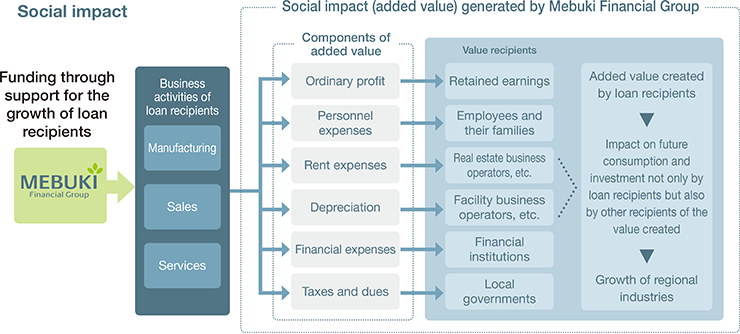
Added value is used as an indicator to quantitatively measure social impact in “Support the growth of local industries,” which is one of the material issues.
Added value is generally used as an indicator to measure the additional value created by a company through economic transactions. Therefore, the aggregation of added value can be considered as additional value brought to society.
The social impact of our Group’s business activities is measured by calculating the added value of local companies that our Group has been proactively supporting in their growth.
The value-added amount is generally calculated using either the subtraction method or the addition method. Since the customer companies subject to measurement span a wide range of industries, we adopt the addition method (Bank of Japan method), which enables analysis of the processes in production or service activities where added value is generated.
Going forward, we will regularly measure the social impact of supporting the growth of local companies by calculating the value added.