
- home
- Sustainability / ESG Information
- Social
- Strengthen human capital and promote DE&I

Mebuki Financial Group, by embodying our Group Philosophy—“Together with local communities, we will continue to build a more prosperous future by providing high-quality, comprehensive financial services”—has been working to develop human resources and an internal environment based on the belief that people are our most important management resource, in order to enhance our corporate value.
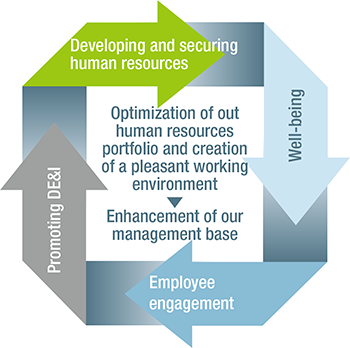
Under the Fourth Medium-Term Group Business Plan, we are creating an environment where talent responsible for value creation can fully demonstrate their individuality and strengths. Through these efforts, we aim to build a human resources portfolio that contributes to improving the Group’s corporate value.
Developing and securing human resources for value creation
Creating a workplace environment where well-being※1 can be truly felt
Promoting DE&I
Increasing employee engagement
At Mebuki Financial Group, we are promoting human resource development so that everyone can aim for career advancement fairly, regardless of age, gender, etc. In addition, we are proceeding with the development of an environment where employees can feel job satisfaction and continue working for a long time, deploying various measures such as initiatives based on the Act on the Promotion of Female Participation and Career Advancement in the Workplace and "Work Style Reform." Furthermore, we have established a "Diversity Promotion Office" within the Personnel Department of both subsidiary banks as an organization to supervise initiatives related to the promotion of diversity across the entire Group. For details on the governance structure for sustainability, please refer to here.
Group Diversity Policy
We will enhance our human capital to realize one of the goals set out in the Group’s Long-Term Vision 2030 of “A Value Creation Group Working Together with Local Communities” by developing and enhancing human resources with the requisite skills and by creating an internal environment where diverse human resources can work actively while fully demonstrating their abilities.
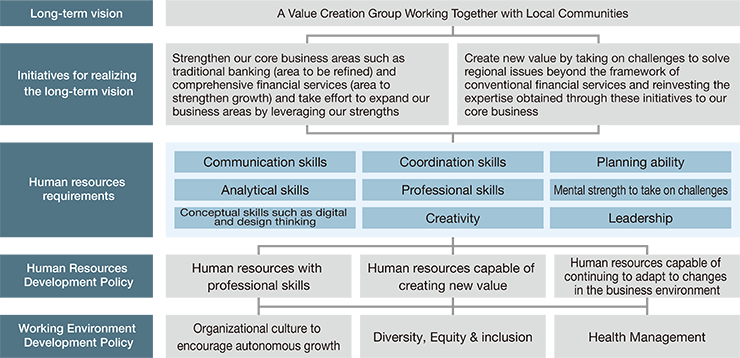
With the Group’s vision set forth as “A Value Creation Group Working Together with Local Communities” (the Long-Term Vision 2030 formulated in April 2022), we intend to surely follow through on initiatives to realize this vision. To this end, the Group believes it is necessary to work on the development and enhancement of human resources not only with deep thoughts on and understanding of the community and financial knowledge but also capable of taking actions to identify and solve challenges faced by the local communities and customers from multiple angles.
Major Initiatives in the Long-Term Vision
Human capital for achieving the long-term vision
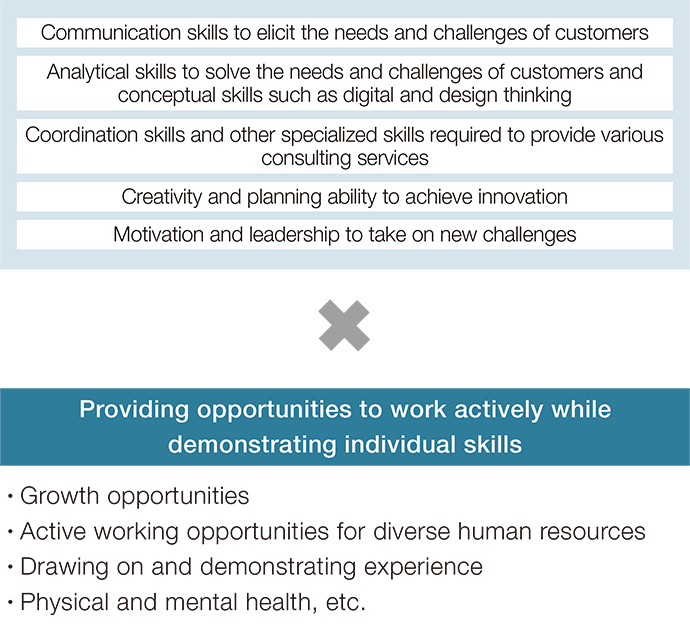
We will enhance our human capital to realize the Group’s long-term vision by developing and enhancing human resources with the following skills and by creating an internal environment where diverse human resources with such skills can work actively while fully demonstrating their abilities.
<Example of human skills required to realize our vision>

To improve problem-solving skills among employees to live up to the expectations and trust of customers, we will work to secure and develop human resources capable of creating new value by developing human resources with specialized skills and meeting the diversified needs of customers.
We will also enhance human resources capable of continuing to adapt to changes in the business environment in the future by enhancing opportunities for reskilling.
We will develop our internal environment based on the following policies so that each individual human resource with diverse knowledge and skills can fully demonstrate their abilities.
Organizational culture to encourage autonomous growth
To promote autonomous growth and a motivation to take on challenges among employees, we will cultivate an organizational culture where employees have a sense that their performance and contributions are properly valued and can feel their own growth and where employees continue to create new value by autonomously carving out their careers. Furthermore, we will create an environment where motivated and skilled employees can work actively and shine in a higher field.
Diversity, Equity & inclusion (DE&I)
In order to remain a corporate group where each individual employee can work actively and grow sustainably, we will form a diverse and self-reliant group to strengthen our organizational power by leveraging diverse views and experience of individual employees irrespective of their age, gender, and other properties.
In order that diverse human resources can work actively in the long term in the Group, we will work to develop a pleasant working environment and develop related systems, while taking into account changes in lifestyles and attitude toward work.
Health Management
We recognize that it is essential that employees are healthy both physically and mentally in order to contribute to the development of local communities and regional economy. Based on this recognition, we provide support for employees to maintain and improve their health so that every employee can work energetically in good health and thus can fully demonstrate their abilities.
【Long-term vision and Human capital】
1. Human resources development
(1) DX personnel and DX basis personnel
The Group regards the development and securing of consulting personnel capable of taking actions to identify and solve challenges faced by local communities and customers from multiple angles as an initiative that we should focus on for the time being.
We have set forth targets for developing DX personnel and DX basis personnel in the Third Medium-Term Group Business Plan and worked to achieve the targets from the perspective of urgently developing and securing personnel who will adapt to the recent advancement of DX and digitalization and act as the basis for reforming the Group’s business model and providing support for customers with their DX and digitalization.
As a result of our efforts to encourage and train employees to acquire IT Passport with the target of achieving 3,000 DX basis personnel by the end of March 2024, we have already achieved the target of 3,000 acquirers more than one year ahead of schedule at the end of December 2022. As of the end of March 2025, the number has reached 4,124.
Targets: Results of developing DX personnel and DX basis personnel
| Target | Target date of achievement | March 31, 2023 | March 31, 2024 | March 31, 2025 | Progress rate | ||||
|---|---|---|---|---|---|---|---|---|---|
| Number of people | Ratio to total employees | Number of people | Ratio to total employees | Number of people | Ratio to total employees | ||||
| DX personnel | 551 | 9.9% | 663 | 12.1% | 992 | 18.2% | 248.0% | ||
| o/w Joyo Bank | 400 people | March 31, 2025 | 253 | 8.2% | 307 | 10.2% | 361 | 12.0% | ― |
| o/w Ashikaga Bank | 298 | 11.9% | 356 | 14.5% | 631 | 25.8% | ― | ||
| DX basis personnel (IT passport acquirers) | 3,538 | 63.3% | 3,924 | 71.7% | 4,124 | 75.6% | 137.5% | ||
| o/w Joyo Bank | 3,000 people | March 31, 2024 | 1,911 | 61.9% | 2,092 | 69.2% | 2,193 | 72.9% | ― |
| o/w Ashikaga Bank | 1,627 | 65.2% | 1,832 | 74.7% | 1,931 | 78.9% | ― | ||
(2) advanced qualification holders
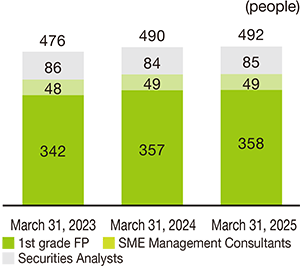
As the scope of consulting services is broad, non DX-related indicators could be an option. However, we have set the numbers of advanced qualification holders (total number of 1st grade Certified Skilled Workers of Financial Planning (1st grade FP), Small and Medium Enterprise Management Consultants (SME Management Consultants), and Securities Analysts) and 2nd grade Certified Skilled Workers of Financial Planning (2nd grade FP) as indicators as the Group’s core business is finance.
In addition, we are working on the development and securing of specialized human resources by encouraging employees to acquire qualifications specific to their areas of expertise.
Breakdown of advanced qualification holders
(3) Actual number of trainees dispatched to inside and outside the Group
The Group believes that self-motivated efforts made by individual employees to improve their skills and build their careers will lead to individual and organizational growth as well as organizational revitalization and building of a strong organization and therefore enable us to realize our management strategies.
It is essential for the Group to provide continuous support for employees to acquire specialized skills and draw on their expertise in a variety of contexts and from various angles. We have therefore been working to achieve the “Number of trainees dispatched to inside and outside the Group,” set out as one of the targets in our Third Medium-Term Group Business Plan, which will allow the trainees to have an opportunity to grow by volunteering to absorb knowledge from inside and outside the Group. A total of 221 persons were newly dispatched within and outside the Group during the three years from fiscal 2022 to fiscal 2024. Since their dispatch, they have been making full use of the specialized skills that they acquired.
As part of efforts to support self-motivated career building among employees, the Group has been increasing the number of trainees dispatched by way of open recruitment and the number of persons assigned under the post challenge program, with the numbers of applicants showing an increase in each year.
In addition to these efforts, we are undertaking initiatives to create an environment to provide employees with support for self-motivated career building and promote their motivation to take on challenges, including holding various holiday lecturers and workshops and enhancing e-learning programs.
Target: Actual number of trainees dispatched to inside and outside the Group (Bank total)
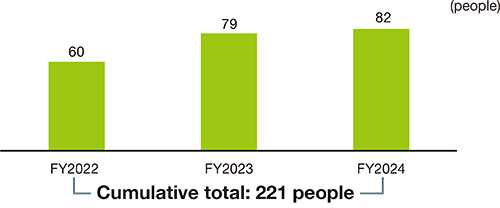
A cumulative total of 221 employees were dispatched over the three years, mainly in the areas of consulting and DX.
We have achieved a target achievement rate of 184.2% with regard to the target of 120 employees set out in the Third Medium-Term Group Business Plan.
(4) Investment in human capital
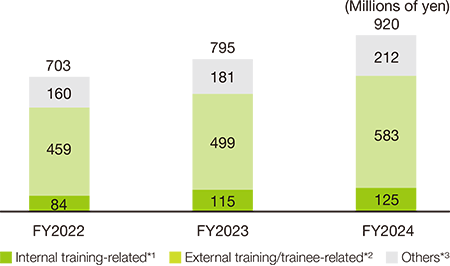
The Group is strengthening its investment in human capital as part of efforts to help improve the capabilities and skills of employees. Cumulative investments during the period corresponding to the Third Medium-Term Group Business Plan (fiscal years 2022 to 2024) totaled approximately 2.4 billion yen.
For the period corresponding to the Fourth Medium-Term Group Business Plan (fiscal years 2025 to 2027), we will set a cumulative total of 3 billion yen in investments over the corresponding three years as a KPI, and further accelerate our investments in human capital. We will continue to support the autonomous growth of our employees and actively develop human resources capable of creating new value.
At the two subsidiary banks of the Group, efforts are being made to visualize employees’ skills in terms of combined “knowledge” and “practical skills,” and to analyze the relationship between investments in human capital and skills.
An analysis※ of a survey conducted on a set of employees of Joyo Bank revealed that, when the skill level increases by one level, the sales performance improves by about 12% on average in the corporate customer category and about 6% on average in the individual customer category. It also revealed that there is a trend toward improvement in skills and sales performance among those who have acquired specific qualifications or participated in training. The analysis also shed light on the characteristics of the Group’s highly skilled human resources. Going forward, the Group will continue to conduct ongoing research and analysis, and work to visualize the return on our investments in human capital as we seek to make ever more efficient and effective investments.
※Approximately 1,500 sales employees were surveyed using “GROW Series:” a set of tools provided by the Institution for a Global Society Corporation, used to measure the capabilities of human resources. The results of this survey were then analyzed.
[Target] “Human capital investment”
2. Securing of human resources
We recognize that, in order to achieve sustainable growth, it is important to work not only on stable new graduate hiring but also on securing human resources with skills necessary to execute our business strategies in accordance with the expansion of business areas, deepening of consulting functions, and progress in the business strategies as there is an imbalance in the age structure of the Group’s human resources portfolio.
We have therefore been strengthening the mid-career recruiting of highly skilled and specialized, work-ready human resources. The number of hires and the ratio of mid-career hires※ are both on the rise.
Indicator: Actual number of mid-career recruitment
| Indicator | FY2022 | FY2023 | FY2024 | |||
|---|---|---|---|---|---|---|
| Number of people | Ratio of mid-career | Number of people | Ratio of mid-career | Number of people | Ratio of mid-career | |
| Number of mid-career | 30 | 14.4% | 68 | 24.2% | 106 | 30.4% |
| o/w Joyo Bank | 12 | 11.7% | 12 | 9.0% | 46 | 28.9% |
| o/w Ashikaga Bank | 18 | 17.0% | 56 | 38.1% | 60 | 31.6% |
※Ratio of mid-career Number of mid-career ÷ Number of annual recruitment
Based on Mebuki Financial Group's human resources portfolio, we recognized that, in order to embody the corporate philosophy and improve corporate value by adapting to rapid changes in the external environment and creating value, it is imperative for the Group to utilize diverse human resources, including women, seniors, and specialized mid-career hires with various experience and to continuously create an environment where they can fully demonstrate their characteristics and abilities. By building an organization where diverse human resources can feel job satisfaction and leverage diverse views and experience, we will create new value and innovations, thereby achieving sustainable growth.
1. Promotion of women to senior positions
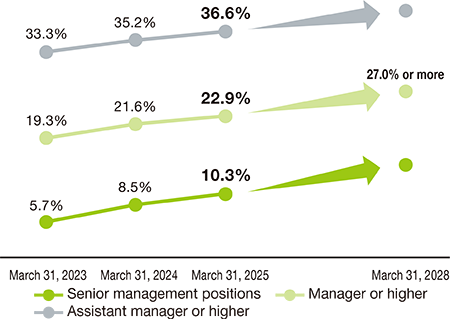
Under the Third Medium-Term Group Business Plan, we have set the ratio of female employees in assistant manager positions or higher as a target indicator for the state of securing the pool of future female management candidates. The target was achieved at the end of FY2023, one year ahead of schedule, as a result of the above efforts. As of the end of FY2024, we have achieved a rate of 36.6%.
In the Fourth Medium-Term Group Business Plan (fiscal years 2025 to 2027), the Group will strengthen its efforts by setting “the ratio of female employees in manager positions or higher” as an important KPI in order to promote the promotion of female employees who can take positions closer to management level and reduce the wage gap between male and female employees. We aim to achieve 30% or higher for this indicator by the end of March 2030, and, as part of the Fourth Medium-term Group Business Plan, to 27% or higher by the end of March 2028.
For results regarding the "Ratio of female employees in assistant manager positions or higher," "Ratio of female employees in manager positions or higher," and "Ratio of female employees in senior management positions," please refer here.
Ratio of female employees in management position (bank total)
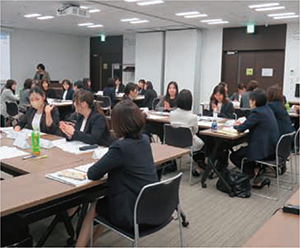
Mebuki Women’s Class
We have led the active participation of group-wide female employees and, since fiscal 2018, held the “Mebuki Women’s Class” at both Joyo Bank and Ashikaga Bank with the aim of fostering women leaders who serve as role models for young female employees. For employees at manager level, the curriculum includes lectures on the Group’s management strategies, the mindset and skills required for higher-level positions, and other topics drawing from a wider perspective by female Outside Directors of the Company. In addition, we also host roundtable discussions of female employees of the Bank who are currently active as General Managers of the Bank branches as a way to provide inspiration for future career advancement.
The number of people who have been active as General Managers of branches of the bank who have already participated in the class has reached more than 15, helping create a virtuous cycle in which the participants become role models and pass on their experiences to their juniors. In addition, women in the same positions across the two banks can gather together for discussion and sharing information, which also proves very useful for personnel exchange and networking between the two banks.
Mebuki Women’s Class
2. Status of gender wage gap
There is no gender wage gap for employees in the same courses, the same positions, or the same lines of work.
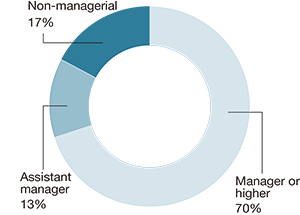
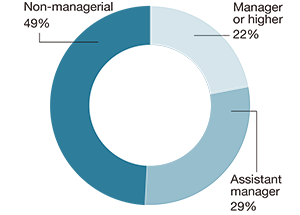
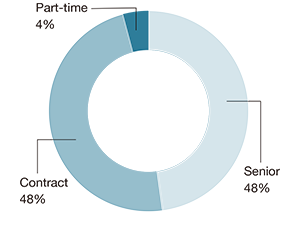
As shown in the table below, there is a gender wage gap in the aggregate. The reasons behind the gender wage gap for different employment status are as follows.
Indicator: Actual gender wage gap
| Indicator | FY2022 | FY2023 | FY2024 |
|---|---|---|---|
| Gender wage gap (regular workers) | 58.2% | 60.4% | 63.0% |
| o/w Joyo Bank | 58.2% | 60.8% | 63.4% |
| o/w Ashikaga Bank | 57.6% | 59.5% | 62.1% |
| Gender wage gap (part-time/fixed-term workers) | 61.5% | 62.1% | 62.8% |
| o/w Joyo Bank | 68.7% | 64.9% | 66.8% |
| o/w Ashikaga Bank | 54.8% | 59.5% | 59.3% |
※Calculation method: Seconded workers and workers on unpaid leave are excluded
Regular workers: Regular bank employees and employees in roles similar to regular bank employees
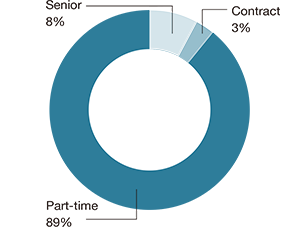
Part-time and fixed-term workers: Contract employees, senior employees (rehired after retirement), part-timers
(part-time and fixed-term workers are calculated based on the number of regular employees at each company in terms of their scheduled working hours)
Personnel composition of regular workers by position
Male
Female
Personnel composition of part-time/fixed-term workers by employment status
Male
Female
3. General Employer Action Plan and Results based on the Act on the Promotion of Female Participation and Career Advancement in the Workplace
(1) Joyo Bank
(2) Ashikaga Bank
1. Expansion of work-life balance systems and promoting the use of childcare leave by men
We have been working to develop and enhance these systems, such as paid holidays and leave systems and shorter working hours, and to deepen company-wide understanding of these same systems so that employees can select their workstyles in tune with life events and balance work and family.
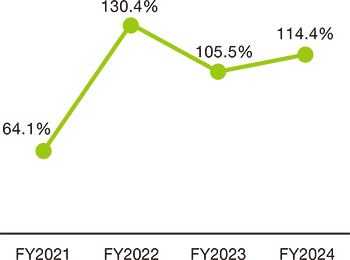
In addition, as the number of dual-income households has increased, promoting the use of childcare leave by men has become an important issue from the perspective of securing human resources. The ratio of male employees taking childcare leave has exceeded 100% since fiscal 2022. The Group will continue to strive to “maintain 100%” moving forward, and, in addition, promote initiatives and awareness-raising to increase the number of days taken.
In order that diverse human resources can work actively in the long term in the Group, we will continue work to develop a pleasant working environment and develop related systems.
【Related systems for enhancing work-life balance】
| Flextime work system | We have introduced a flexible working system that permits employees to schedule when to start and leave work on working days on their own. |
|---|---|
| Working from home | We have helped our employees work efficiently by leasing them mobile PCs so they can work from home. |
| Second job system | We have introduced a second job system for all employees with the aim of improving their own skills, achieving their personal growth, and contributing to local communities in various aspects (Participants as of March 31, 2025: 61). |
| Self-care leave and wellness leave | The Company has expanded its existing system for paid menstrual leave so that it can be used when it is difficult for an employee to work due to undergoing a complete medical checkup, various health checks, or menopausal symptoms. |
| Fertility treatment leave system | The system allows employees to continue to work with a sense of security while receiving fertility treatments. Employees can take leave for two years at maximum. |
| Work in casual clothes | We have introduced a system that allows employees to work in casual clothes on condition that they choose what to wear according to the time, the place, and the occasion as well as the business settings. |
[Indicator] “Ratio of male employees using childcare leave” (bank total)
2. Strengthening of initiatives for improving health management and financial wellness
The Group recognizes that, in order for a company to stay healthy, it is essential that each and every employee is healthy both physically and mentally. In accordance with the Health Management Declaration, we have been making efforts to detect diseases at early stage and prevent disease aggravation and development of lifestyle diseases among employees by such means as offering complete medical checkup and periodic health checkup programs, from the perspective of maintaining and improving their physical health.
At the same time, we are also working to improve physical and mental health among employees by undertaking initiatives for mental health promotion, such as conducting a stress check and setting up counselling desks for all employees, as well as those for achieving a better work-life balance.
We believe that realizing a better life of employees in terms of asset building has a positive effect on their physical and mental health and is imperative for the Group and employees to grow together. Based on this belief, we are working to enhance our welfare program, including a shareholder association and defined contribution pension plan, to support their asset building.
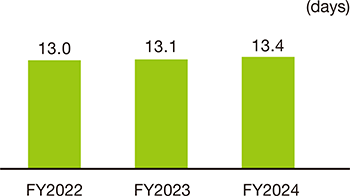
[Indicator] Actual “Average number of paid leave days taken” (bank total)
| Health management measures |
|
|---|---|
| Initiatives for financial wellness |
|
For external evaluations, please refer here.
Revitalization of self-motivation type activities for helping find solutions to workplace issues
Both banks conduct engagement surveys to maximize the potential of each employee, create a workplace environment where employees can work with motivation and fulfillment, and improve organizational capabilities.
The banks periodically conduct surveys, share the results with employees, and continue improvement initiatives tailored to the actual situation in each workplace, including the hosting of meetings and formulating action plans for any issues identified. As a result of these initiatives, survey scores have also been on an upward trend.
Through these initiatives aimed at improving engagement, we will continue our efforts to create a fulfilling workplace and improve organizational capabilities by increasing the number of employees who proactively tackle problem-solving.
Changes in survey score
Joyo Bank (Tool used: Wevox)
| November 2022 (initial survey) | February 2025 |
|---|---|
| 71 points | 75 points |
The average for financial institutions of similar size is 68 points, with performance of the bank comparing favorably.
Ashikaga Bank (Tool used: Qualtrics EmployeeXM)
Percentage of positive responses to engagement questions
| November 2023 (initial survey) | January 2025 |
|---|---|
| 52% | 62% |
Positive response rate increased by +10%
We recognize that risks related to human capital can become either risks or opportunities depending on how we respond to them.
We recognize the risks and opportunities of human capital as follows, and while responding to them, we acknowledge the need to strengthen investment in human capital.
1. Rapid Changes in the External Environment and Diversification of Lifestyles and Values
| Changes in Social/Economic Trends and Environmental Awareness | The speed of environmental change is increasing, and rapid changes are expected to continue. In addition, the sharing economy and experience-based consumption are expanding, and awareness of social issues at the individual level, such as decarbonization and SDGs, is increasing. As uncertainty in the surrounding environment increases, stakeholder expectations are focused on how our Group will contribute to the realization of sustainable local communities. We recognize the need to transform our Group's business through the development and securing of human resources who create value and through the brilliance of our employees. |
|---|---|
| Risks |
Due to increased competition in the recruitment environment and outflow of human resources due to increased labor mobility, and delays in responding to external changes stemming from insufficient training and an inability to meet diversifying customer needs:
Due to the failure to obtain expected results from investment in human capital and the stagnation in securing and developing human resources capable of value creation:
|
| Opportunities |
By enhancing human resources capable of responding to changes in the external environment and meeting customer needs:
|
| Direction of Response |
【Securing Human Resources】 【Human Resources Development】 |
2. Diversity and Transformation of Work Styles
| Changes in Social/Economic Trends and Environmental Awareness | Promotion of active participation by diverse human resources, going beyond the promotion of women's active participation, is attracting social attention. Corporate transformation utilizing the liquidity of human resources, such as side jobs and mid-career recruitment, and personnel with different corporate cultures is also becoming active. Work styles that do not require commuting to the workplace, such as working from home and remote work, have become common, and such work styles are expected to continue and become established. |
|---|---|
| Risks |
Due to diverse human resources being unable to exercise their potential and failure to adapt to changes in working styles and awareness:
|
| Opportunities |
By strengthening response to diversity, realizing a workplace without a gender gap, and reviewing working styles:
|
| Direction of Response | We are working to further expand opportunities for women's active participation through the deployment of measures to promote women's active participation. We have set and manage the ratio of female employees in positions of deputy manager or higher as a KPI. In addition to strengthening initiatives for mid-career recruitment, we have introduced a side-job system across the entire Group for the purpose of skill improvement, self-growth, and multifaceted contribution to local communities. We are developing systems to increase the flexibility of work styles, such as the introduction of flextime systems and remote work. We will continue "Health Management," including environmental development and health investment to enable employees to work healthily both physically and mentally, aiming for organizational revitalization such as improvement of employee vitality and productivity. |
3. Progress of Declining Birthrate and Aging Population
| Changes in Social/Economic Trends and Environmental Awareness | Amid concerns about declining regional vitality due to the acceleration of the uneven distribution of the population, we recognize the need to create an environment where employees in child-rearing and elderly stages can work with peace of mind and where employees themselves and their families can live more affluent lives. |
|---|---|
| Risks |
Due to the decline in the working-age population:
|
| Opportunities |
By securing diverse workers and working styles:
|
| Direction of Response | We are working to promote the active participation of human resources through the development of young human resources and women through various opportunities and the utilization of senior employees. In particular, the number of personnel aged 60 and over is expected to increase in the Group in the future, and organizational contribution such as the utilization of knowledge and experience possessed by senior employees will become even more important. We will proceed with the development of a system where senior employees can maintain high motivation and play an active role, including extension of retirement age and review of treatment. We are working on the enhancement of support systems for balancing work and family, such as promoting the acquisition of childcare/nursing care leave and paid leave, and environmental development that enables flexible work styles according to life stages. |
4. Progress of DX and Digitalization
| Changes in Social/Economic Trends and Environmental Awareness | The wave of digitalization is further expanding and accelerating. It is essential for our Group to promote DX, such as fundamentally reviewing business and operations, and we recognize that the speed and method of responding to digitalization, which is expected to accelerate further in the future, is a risk that determines the growth of the entire Group. |
|---|---|
| Risks |
Due to a shortage of highly specialized human resources and delays in responding to DX and digitalization:
|
| Opportunities |
By enhancing highly specialized human resources and advancing DX and digitalization:
|
| Direction of Response | In order to create added value by leveraging the Group's strengths, we are working on the utilization of digital technology to maximize customer experience value, expand non-face-to-face channels and improve convenience, and develop human resources to promote DX for its realization. As the value of human connection is considered to increase more than ever due to the progress of digitalization, we will enhance human power and provide sophistication of communication, peace of mind, and added value through the two wheels of face-to-face consultation/consulting and digital technology. |
5. Compliance
| Changes in Social/Economic Trends and Environmental Awareness | Compliance response is not just about observing laws and regulations; the perspective of "whether the action is socially acceptable" has become even more important. This is a theme of high importance for sustainable business activities, and we recognize that expectations and requirements for Corporate Social Responsibility (CSR) will continue to rise. |
|---|---|
| Risks |
Due to a decline in employee morale:
Due to mental health issues, harassment, and long working hours:
|
| Opportunities |
By enhancing employee ethics and integrity:
|
| Direction of Response | The Group strives to foster compliance awareness and, in order to practice actions that prioritize compliance, we are working to ensure thorough compliance by conducting level-specific training, including human rights issues such as harassment and the prevention of corruption and misconduct. We will endeavor to understand the current situation through instilling corporate ethics, ensuring the effectiveness of the internal reporting system, and employee awareness surveys/engagement, and will enhance the sense of ethics and integrity as individuals and as an organization. |