

- home
- Sustainability / ESG Information
- Environment
- Addressing opportunities and risks related to climate change and natural capital (TCFD, TNFD, etc.)

Economic development is dependent on social conditions such as livelihood and education, and society is supported by the natural environment. Therefore, the maintenance and conservation of the environment is a prerequisite for realizing sustainable local communities and achieving the sustainable growth of both local communities and the Group. We recognize that responding to climate change and environmental conservation is one of the key factors in our business strategy. Going forward, we will continue to strive to reduce the environmental burden of our corporate activities and strengthen our efforts for environmental conservation through our business activities, such as by providing services that contribute to environmental conservation and motivating the supply chain. We will also proactively disclose information based on the TCFD/TNFD Recommendations, thereby further enhancing stakeholder engagement.
Mebuki Financial Group shows its stance on initiatives to address environmental issues in its Corporate Ethics, the basic policy in conducting its business activities, and engages proactively in environmental conservation activities through its group companies. We recognize that responding to climate change and environmental conservation are important social issues related to sustainability, and have identified "Contribute to Realizing a Decarbonized Society and Environment Conservation" as a materiality, which we manage and supervise as part of our governance structure for sustainability.
Formulation of policies
As group-wide policies for initiatives for sustainability* issues including response to climate change and environmental conservation, Mebuki Financial Group has formulated Group Sustainability Policy, Group Environmental Policy, Group Human Rights Policy, Environmentally and Socially Friendly Investments and Loans Policy, and Procurement and Purchasing Guidelines. Positioning the sustainability issues as important management agendas, the Group operates its business based on these policies.
*Initiatives for achieving both the sustainable growth of the Group and the resolution of environmental/social issues in local regions
Human rights policy and engagement activities
In accordance with the Group Human Rights Policy, in order to respect the basic human rights of all stakeholders, we are committed to respecting human rights by paying attention to the negative impacts on human rights from the corporate activities of our borrowers and suppliers (supply chain).
For more details about the Group Human Rights Policy, please see https://www.mebuki-fg.co.jp/eng/sustainability/pdf/group_human_rights_policy.pdf
Main matters related to response to climate change and environmental conservation discussed by the Sustainability Committee in FY2024
The Group conducts financial impact assessments based on the identification of climate change risks and opportunities that are expected to impact its business activities. Based on the assessment results, we are taking actions to mitigate risks and capture opportunities, such as reducing CO2 emissions from the Group’s business activities, participating in renewable energy power businesses through group companies, and proactively supporting climate change measures by providing funds and consulting services to customers.
1. Risks
(1) Awareness of risks
We are aware of climate change-related risks as follows:
| Risks | Details | Time frames | |
|---|---|---|---|
| Physical risks |
|
|
Short- to long-term |
| Transition risks |
|
|
Medium- to long-term |
|
|
Short- to long-term |
※Short-term: approx. 5 years; medium-term: approx. 10 years; long-term: approx. 30 years
(2) Scenario analysis
The Group conducts the scenario analysis of physical risks and transition risks to assess the resilience of the Group while taking into consideration climate change scenarios and to enhance dialogue (engagement) with its corporate customers. In the ongoing scenario analysis, the Group pursues the sophistication of analytical methods and the expansion of the scope of analysis. Here is the overview of the scenario analysis in FY2024.
Physical risks
Ⅰ Qualitative analysis
We analyze the risks faced by our customers from the perspective of physical risks.
| Evaluation items | Main risks |
|---|---|
| Increased severity of extreme natural disasters (acute risks) |
|
Ⅱ Procedures for analysis
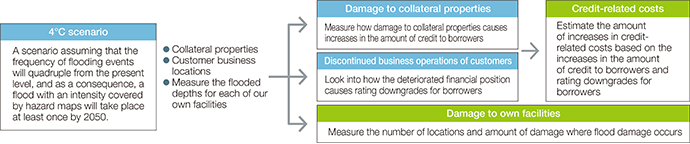
We have analyzed how damage to collateral properties and the deteriorated financial position of customers due to the discontinued business operations will affect the Group’s credit-related costs over time. We made the analysis based on materials published by the Ministry of Land, Infrastructure, Transport and Tourism and other information, assuming the 4°C scenario in which the level of flood falling under the natural disasters on hazard maps takes place. We have also analyzed the damage to our own facilities within the Group in similar situations. Furthermore, based on this analysis, we have conducted a more detailed analysis of customer information than ever before, utilizing data from Green Page and by expanding the number of our business locations we draw on for information.
【Overview of analysis】
| Risk events | From flooding | |
|---|---|---|
|
|
|
| Scenarios | RCP8.5 scenario※ according to IPCC (4℃ scenario) | |
| Subject of the analysis | Customers with their business locations in Japan | All own buildings in Japan |
| Period of analysis | Until 2050 | |
| Risk metrics | Credit-related costs (credit costs) that will likely increase | The number of locations and amount of damage where flood damage occurs |
| Amount of risk | Increase in credit-related costs: Up to ¥15.7 bn | The number of locations: 102 (16.6% of all locations) Amount of damage: Up to ¥1.4 bn |
※A scenario developed by IPCC
Transition risks
Ⅰ Selection of sectors subject to the analysis
In view of transition risks (Policy and Legal, Industry and Market, Technology, and Reputation), we picked out Electricity, Petrochemical, Automobile, and Metals and Mining from our investments and loans portfolio as the four sectors that will be affected most by transition risks, and have analyzed the potential risks customers will face in these sectors.
Ⅱ Quantitative analysis
Procedures for analysis
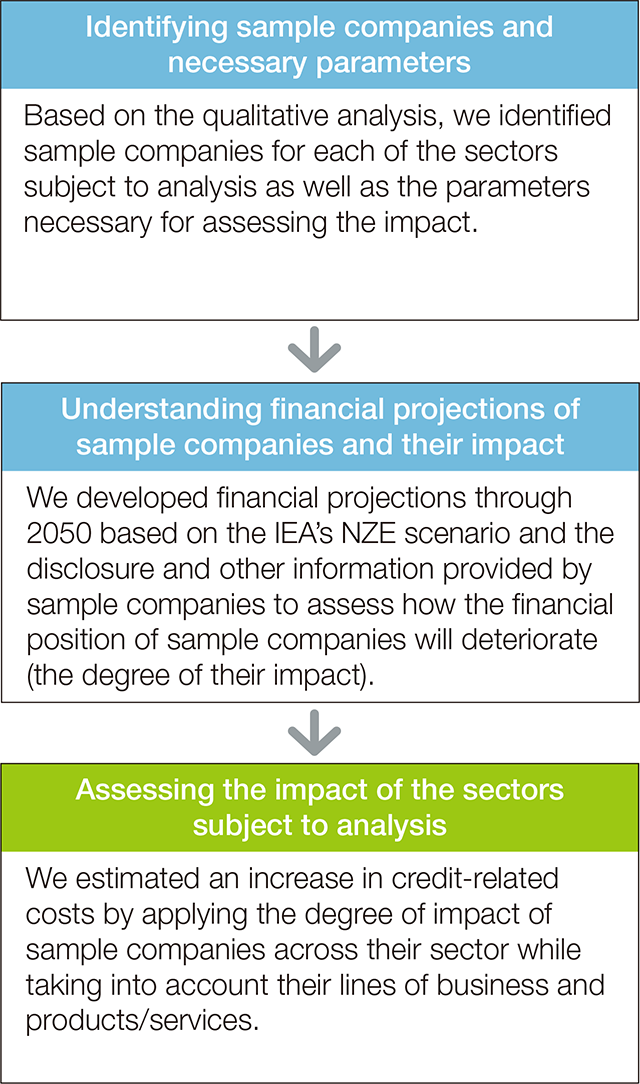
We have conducted quantitative analyses on the impacts of the introduction of carbon tax, customers’ initiatives, changes in the markets, and others, which are all aimed at the transition to a decarbonized society. Specifically, we have analyzed how the deteriorated financial position of customers, as a consequence of the transition to a decarbonized society, will affect the Group’s credit-related costs over time based on the projections under the International Energy Agency (IEA)’s Net Zero Emissions by 2050 Scenario and the disclosure and other information provided by sample companies.

【Overview of analysis】
| Risk events | Deteriorated financial position of customers as a result of the transition to a decarbonized society |
|---|---|
| Scenarios | NZE scenario※1 (1.5℃ scenario), RCP2.6 scenario※2 (2℃ scenario) |
| Subject of the analysis | Electricity, Petrochemical, Automobile, and Metals and Mining |
| Period of analysis | Until 2050 |
| Risk metrics | Credit-related costs (credit costs) that will likely increase |
| Amount of risk | Increase in credit-related costs: Up to ¥19.2 bn |
(3) Results of the scenario analysis
This analysis approach found that both physical risks and transition risks have limited impacts on the Group. We will use analysis results for our customer engagement and support our customers in making efforts to address climate change and toward decarbonization, thereby aiming to maximize opportunities and minimize risks for the Group and customers as we continue to strive to evolve our analysis.
(4) Status of carbon-related assets
As one of our efforts to understand climate change-related risks, the Group is working to understand the status of transactions with carbon-related sectors, which are considered to be more susceptible to financial impacts from climate change-related risks than other sectors. The amount of credit for carbon-related sectors※1 in the Company’s total amount of credit※2 and the percentage of loans to these sectors of the Company’s total loans are indicated below.
| Sector | Energy | Transportation | Materials and Buildings | Agriculture, Food, and Forest Products | Total |
|---|---|---|---|---|---|
| Amount of credit | ¥180.5 bn | ¥497.0 bn | ¥3,258.3 bn | ¥302.3 bn | ¥4,238.0 bn |
| Percentage | 1.4% | 3.9% | 25.7% | 2.4% | 33.5% |
2. Opportunities
(1) Awareness of opportunities
We are aware of climate change-related opportunities as follows:
| Details | Time frames | |
|---|---|---|
| Increased business opportunities |
|
Short- to long-term |
| Cost reduction |
|
Short- to long-term |
| Enhanced social reputation |
|
Medium- to long-term |
※Short-term: approx. 5 years; medium-term: approx. 10 years; long-term: approx. 30 years
(2) Efforts to seize the opportunities we are aware of
Making efforts to achieve carbon neutrality and preparing for natural disasters, which are becoming increasingly severe and ever more frequent as the planet heats up, are essential for business continuity and sustainable growth and have become important management issues, not just for listed and larger companies, but also for small and medium-sized local enterprises. In light of such circumstances, the Group actively supports its corporate customers in taking climate change measures by providing funds and consulting services. (Please see here for details.)
The Group has analyzed the dependence and impact of its business activities on nature, as well as the risks and opportunities, with reference to the TNFD Recommendations. We will continue to conduct more surveys and research and work to increase the sophistication of our analysis.
1. Dependencies and impacts
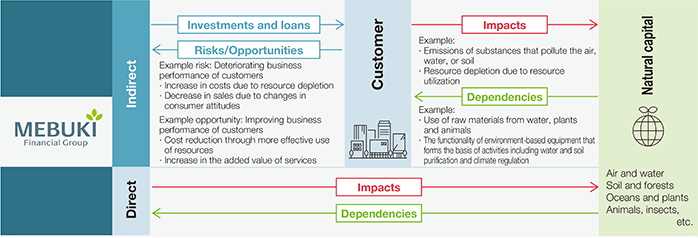
Many companies, including those within the Group, conduct business in connection with nature. As a financial services company with the banking business at the core, the Group believes it is necessary to understand not only the direct dependencies and impacts of its business activities on nature but also the indirect dependencies and impacts on nature through its investment and loan activities. Therefore, we utilized ENCORE※ data to analyze and organize the dependence and impact on nature for the top sectors of the Group in terms of investments and loans.
※ENCORE (Exploring Natural Capital Opportunities, Risks and Exposure) is an analytical tool developed by the United Nations Environment Programme World Conservation Monitoring Centre (UNEP-WCMC) and the Natural Capital Finance Alliance (NCFA). It enables analysis of dependence on and impact on nature by sector.
(1) Results of analysis
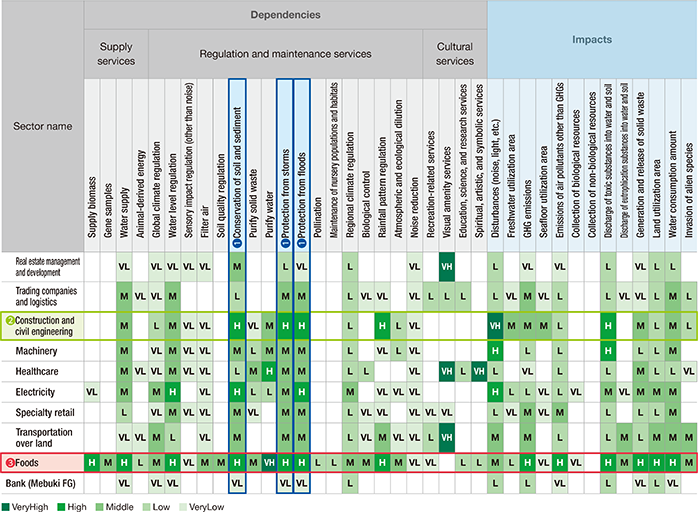
As a result of this analysis and organization, it was found that the ecosystem services with a high dependency across sectors are “Conservation of soil and sediment,” “Protection from storms,” and “Protection from floods.” We also identified “Construction and civil engineering” and “Foods” as sectors with a high relevancy to nature, and organized their characteristic relationships with nature for each sector. (For details, please refer to “Heat Map Analysis” on the next page.)
In order to maintain such ecosystem services, it is important to maintain and bolster natural assets such as forests, as well as to restrict emissions of greenhouse gases and other sources of emissions that can have a negative impact on the natural environment, protect against overconsumption of natural resources, and effectively utilize recyclable resources.
(2) Response based on analysis results
Based on analysis results, the Group will continue to support customers’ decarbonization efforts, promote the sales of forest-derived carbon credits, actively engage in tree planting and other nature conservation activities, and enhance the sophistication of the analysis.
Group’s Relationship with Natural Capital
Heat Map Analysis
| Sector name | Highly dependent and impactful relationships with nature | Remarks |
|---|---|---|
| ❶ Common across sectors |
Dependencies
Conservation of soil and sediment
Protection from storms Protection from floods |
Localized disasters such as storms, floods, and landslide pose a significant threat to the lives and health of people, as well as to property, and may impact a large number of business activities. Forests, coral reefs, seagrasses, wetlands, and other natural barriers and buffer zones serve to mitigate the effects of natural disasters. |
| ❷ Construction and civil engineering |
Dependencies
Rainfall pattern regulation: H
|
Forests and other vegetation maintain rainfall through evapotranspiration and recycle water back into the atmosphere. In addition to maintaining ecosystems such as wetlands and rivers, and supplying the water necessary for the stable growth of agricultural crops, the appropriate regulation of rainfall patterns also has the function of preventing rivers from rising rapidly. In particular, construction, demolition, and civil engineering all depend on being able to mitigate the risk of damage onsite from flooding, etc. |
|
Impacts
Disturbances (noise, light, etc.): VH
Discharge of toxic substances: H |
Noise and light emissions during the construction, dismantling and waste treatment processes, as well as spills of toxic chemicals (in paints and solvents, etc.) can contaminate water and soil, adversely affecting species populations and habitats. | |
| ❸Foods |
Dependencies
Water purification: VH
Water supply: H Water level regulation: H |
Agriculture, livestock and dairy, fisheries and food production activities require large quantities of high-quality water for crop cultivation, cleaning and hygiene management. For this reason, we depend on the ecosystem services provided by the forests, soils and microorganisms that purify the water, and the wetlands and rivers that appropriately regulate the level of water. |
|
Impacts
Water consumption amount: H
|
On the other hand, the use of large amounts of water makes it difficult for residents and other industries to secure the water they need, especially in areas with limited water resources, seriously affecting quality of life and economic activity. |
2. Risks and opportunities
(1) Awareness of risks
The TNFD classifies nature-related risks as potential threats to the organization arising from its dependencies on and impacts on nature into three categories: physical risks, transition risks, and systemic risks.
For details of the risks that the Group is currently aware of, please refer here.
(2) Awareness of opportunities
The TNFD divides nature-related opportunities into those related to business performance and those related to sustainability performance and states that the two categories are not mutually exclusive.
For details of the opportunities that the Group is currently aware of, please refer here.
(3) Efforts to address the risks and seize the opportunities we are aware of
Although the qualitative analysis has organized the Group’s relationship with nature, we believe that we need to further evolve our analysis in order to implement specific strategies.
Going forward, we will strive to evolve our analysis, including quantitative analysis that takes into account geographical characteristics and the characteristics of each sector, in order to minimize risk and maximize opportunities for the Group, local communities, and our customers.
The Group has worked to have a more sophisticated risk management system based on the recognition that one of its most important management issues is to appropriately control risks according to the characteristics of business operations and risks in order to enhance its corporate value while ensuring its sound and safe corporate management. We will continue to work to improve our risk management system, and at the same time, we will develop and provide optimal solutions to the issues and needs we have identified through engagement with our customers, and we will strive to create business opportunities while reducing and avoiding risks.
1. Top risk management
Of the risk events that have an impact on the Group’s management and strategies, those deemed particularly significant in terms of likelihood, potential impact, or public attention are designated as top risks by the Board of Directors. For these top risks, we implement predictive management and risk control measures based on risk scenarios.
With regard to climate change and natural capital, the Group has identified the “delayed response to climate change and environmental issues” and the “occurrence of large-scale earthquakes and storm damage, etc.” as top risks, and is managing these risks accordingly.
2. Integrated risk management
The Group undertakes integrated risk management which quantitatively measures various types of risk including credit risk and market risk, using statistical methods, such as VaR, in order to individually manage increasingly diversified and complicated types of risk relevant to financial services, and at the same time, to comprehensively capture said risks.
3. Formulation of “Environmentally and Socially Friendly Investments and Loans Policy”
In March 2021, the Group established the Environmentally and Socially Friendly Investments and Loans Policy based on which we sought to reduce or avoid investments on sectors that may have a negative impact on the environment and society.
In conjunction with the launch of the Fourth Medium-Term Group Business Plan, the Group revised this Environmentally and Socially Friendly Investments and Loans Policy in order to further strengthen its efforts to realize sustainable local communities through more active support for initiatives aimed at finding solutions to environmental and social issues, as well as by responding more prudently to investments and loans that may have a negative impact on the environment and society.
We will continue to engage in investment and loan activities in accordance with the said investment and loans policy, and regularly monitor whether or not the operations being conducted are appropriate.
4. Spread of climate change risks
Given the results of the scenario analysis and qualitative analyses, we recognize that climate change risks could permeate and materially affect the Group’s business operations, strategies, and financial planning by way of credit risks, operational risks, and a broad range of complex pathways over a variety of time frames.
In order to understand and assess the impact of climate change on the Group’s business, we consider the ripple effects of potential climate change risks. Based on this, we conduct a scenario analysis to identify the current risks and opportunities associated with climate change.
| Physical risks | Transition risks | |
|---|---|---|
| Credit risk | Increase in credit risk due to damage to customers’ assets, caused by the increased severity of natural disasters and the subsequent impairment of collateral values, and to the slow-down/deteriorated earnings of customers’ businesses | Deterioration in earnings of customers and subsequent increase in credit risk for reasons including their insufficient responses to changes associated with the transition to a decarbonized society, such as the changes in policies/regulations, markets, and technological development |
| Market risk | Increase in market risk with the declining values of securities, etc., caused by the increased severity of natural disasters | Deterioration in earnings of investees on the back of the transition to a decarbonized society, increase in market risk coupled with a decline in the values of securities and other instruments caused by changes in investor behavior |
| Liquidity risk | Increase in liquidity risk coupled with increased outflow of funds due in part to the withdrawal of deposits by customers who were affected by the increased severity of natural disasters, and as a consequence, are cash-strapped | Increase in liquidity risk coupled with increased funding costs on the back of a rating downgrade of the Group due in part to its insufficient response to climate change risks and the outflow of deposits |
| Operational risks | Increase in tangible asset risk, discontinued business operations, and increase in disaster prevention costs as a consequence of damage to the Group’s business locations by natural disasters | Increase in reputational risk due to insufficient responses to the transition to a decarbonized society (e.g., insufficient disclosure, holding of carbon-related business assets) |
5. Natural capital-related risk and impact management
The analysis of natural capital is limited to qualitative analysis, including analysis through the preparation of heat maps using ENCORE. In order that we are able to better manage risk and impact, the Group recognizes that it is necessary to further enhance its analysis processes, including through the identification of priority sectors and regions and the conducting of quantitative analysis.
Moving forward, we will work to improve our analysis of risks and opportunities by conducting analyses of natural capital and using scenario analysis that takes into account geographical characteristics. At the same time, we will deepen our analysis of the impact and timeframe for each risk category, including credit, market, and operational risks, as we strive to build a comprehensive risk management system.
The Group has set the targets and created a roadmap for the realization of a decarbonized society and nature positivity, and monitors them with various metrics. We regularly report the progress made toward the targets and the use of metrics to the Sustainability Committee and the Board of Directors, reflect them in the strategy, and receive supervision.
1. Sustainable finance
We have set targets to execute sustainable finance for a cumulative total of ¥3 trillion over the period from FY2021 to FY2030 (of which, ¥2 trillion is for environmental sectors), and are proactively working to achieve these targets. (Please see here for details.)
2. CO2 emissions
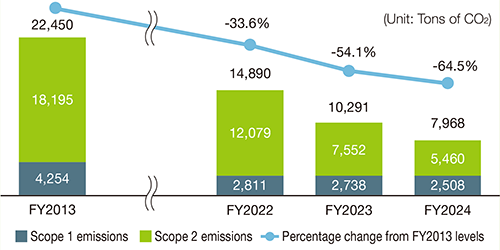
We have set a target of achieving net zero CO2 emissions (Scope 1 and Scope 2) across the entire Company Group by FY2030, and we are working to achieve this goal.
(1) Scope1, Scope2
FY2024 results: 64.5% reduction from FY2013 levels
Main initiatives in FY2024
Energy-saving
Use of renewable energy
(2) Scope 3
The sum of Scope 3 emissions of Joyo Bank and Ashikaga Bank for FY2024 is as follows:
| Category | Emissions (tons of CO2 eq) |
|---|---|
| ①Products and services purchased | 13,981 |
| ②Capital goods | 9,328 |
| ③Fuels and energy activities not included in Scope 1 and Scope 2 | 2,533 |
| ④Transportation and delivery (upstream) | 468 |
| ⑤Waste generated through business | 27 |
| ⑥Business trips | 1,081 |
| ⑦Commuting of employees | 3,248 |
| ⑮Investments and loans | 29,452,756 |
| Total | 29,483,426 |
※No emissions were measured for Categories 8 through 14.
※Categories 1 to 7 are calculated with reference to the “Basic Guidelines on Accounting for Greenhouse Gas Emissions Throughout the Supply Chain (ver. 2.7)” (March 2025, Ministry of the Environment and Ministry of Economy, Trade and Industry) and the “Emission Intensity Database for Calculating Greenhouse Gas Emissions of Organizations through Supply Chains (ver. 3.5)” (March 2025, Ministry of the Environment).
※Category 15 is calculated in accordance with the calculation standards of Partnership for Carbon Accounting Financials (PCAF), an international initiative to develop methods for measuring and disclosing GHG emissions in investment and loan portfolios
Category 15 (investments and loans)
In this fiscal year, we began using Persefoni, a PCAF-approved carbon accounting platform, through which we have worked to expand the scope of our calculations and to increase the sophistication of our calculation methods (including calculations using DQ5).
In addition to the aforementioned expansion of the scope and refinements of our calculations, moving forward, we will also use these calculation results for our customer engagement and to contribute to the realization of a decarbonized society.
Please see here for details.
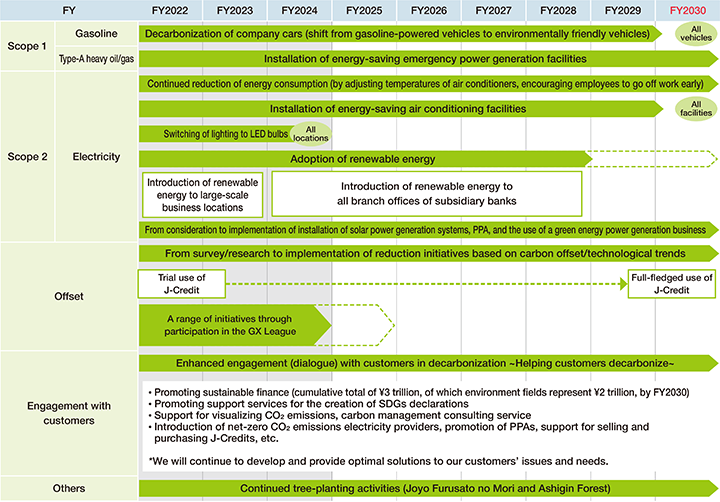
(3) Roadmap for reducing CO2 emissions
In order to achieve the Group’s long-term sustainability KPI of net zero CO2 emissions by FY2030 (Scope 1 and Scope 2), we are working to reduce emissions from the Group’s business activities based on the roadmap (created in June 2022), and we also support our customers’ decarbonization efforts through engagement activities.
We will continue to work at achieving the target by reviewing and revising the roadmap, as needed, in light of factors such as technological trends and changes in environment.
3. Internal Carbon Pricing (ICP) system
In order to further strengthen its decarbonization efforts, the Group introduced Internal Carbon Pricing (ICP)※ system.
Currently, when considering the introduction of equipment, we calculate the CO2 emissions from that equipment in monetary terms and incorporate them into investment decisions, which is used to reduce CO2 emissions and raise awareness within the Group.
The price was set with reference to the NZE Scenario (assuming the achievement of net zero CO2 emissions by 2050) by IEA, a public organization that publishes long-term carbon price forecasts. We will continue to monitor trends and review as appropriate.
※An initiative in which companies voluntarily assign a price to the amount of carbon dioxide they emit in the course of their business.